
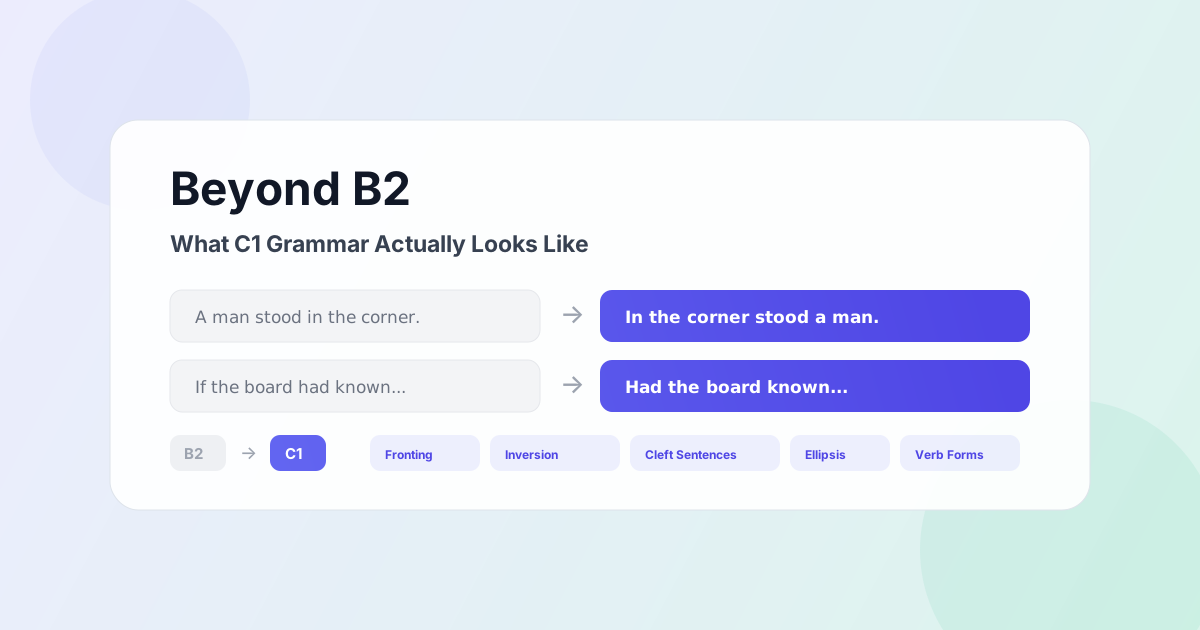
Beyond B2: What C1 English Grammar Actually Looks Like
You passed B2. Your grammar is correct. You can write essays, hold conversations, and survive job interviews in English.
So why does your writing still sound like a textbook?
Because B2 is about being correct. C1 is about being sophisticated — controlling emphasis, register, and sentence rhythm the way educated native speakers do without thinking about it.
The jump from B2 to C1 isn't learning more rules. It's learning to manipulate the rules you already know.
Here are 5 patterns that make the difference.
1. Fronting: Move It to the Front
At B2, you write sentences in standard Subject-Verb-Object order. At C1, you learn to reposition elements for dramatic or academic effect.
| B2 (correct but flat) | C1 (emphasis through word order) |
|---|---|
| A tall figure in black stepped through the curtain. | Through the heavy curtain stepped a tall figure in black. |
| The days when you could leave your door unlocked are gone. | Gone are the days when you could leave your door unlocked. |
| Although it may seem strange, this method works. | Strange though it may seem, this method works. |
This is called fronting — moving a location, predicate, or adjective to the front of the sentence. Some types trigger subject-verb inversion ("stood a tall figure"), others don't. The rules aren't complex, but they're precise.
Fronting is everywhere in literary fiction, academic papers, and formal speeches. Once you notice it, you can't un-notice it.
2. Inverted Conditionals: Drop the "If"
B2 learners write conditionals with "if." C1 learners know you can remove "if" entirely by inverting the subject and auxiliary — and it sounds immediately more formal.
| B2 | C1 |
|---|---|
| If the researchers had noticed the error… | Had the researchers noticed the error… |
| If the company were to merge… | Were the company to merge… |
| If any problems arise… | Should any problems arise… |
Three patterns, three auxiliaries: Had, Were, Should. That's it.
You'll find these in legal documents, academic writing, and business reports. They signal that you're writing at a professional level — not translating from your first language.
3. Cleft Sentences: Control What Gets Noticed
Standard sentences treat all information equally. Cleft sentences let you spotlight exactly what matters.
| B2 | C1 |
|---|---|
| The finding that bilingual children develop stronger problem-solving skills is significant. | Of particular significance is the finding that bilingual children develop stronger problem-solving skills. |
| Economic growth doesn't always improve living standards. | It's not that economic growth is irrelevant; it's that it doesn't always improve living standards. |
The second versions do something the first ones can't: they frame the argument before delivering the information. Academic writing runs on this pattern.
C1 cleft sentences go beyond basic "It was John who…" structures. You learn reversed clefts (Transparency is what voters demand), inferential clefts (It's not that X; it's that Y), and academic fronting (Of particular interest is…).
4. Ellipsis: Say Less, Mean More
B2 learners write everything out. C1 learners know what to leave out.
| B2 (fully explicit) | C1 (ellipsis) |
|---|---|
| She can speak French, and he can speak French too. | She can speak French, and so can he. |
| Although the proposal was flawed, the committee approved it. | Although flawed, the committee approved it. |
| I don't think so. / I think so. | It would appear so. / I fear not. |
Ellipsis isn't about being lazy. It's about register — formal English systematically drops elements that informal English keeps. "So can he" is tighter than "he can too." "Although flawed" is more academic than writing out the full clause.
At C1, you learn formal substitution patterns (do so, that of, those of), reduced adverbial clauses, and clausal substitution (It would appear so). These are the patterns that make your writing sound professional rather than just correct.
Practice ellipsis & substitution →
5. Complex Verb Forms: Add Time and Voice
B2 learners choose between gerund and infinitive: "I enjoy swimming" vs "I want to swim."
C1 learners add temporal and voice dimensions:
| Form | Example | What it expresses |
|---|---|---|
| Perfect infinitive | He is said to have lived abroad. | Past action reported now |
| Passive infinitive | The policy is expected to be announced tomorrow. | Subject receives the action |
| Perfect gerund | She recalled having seen the document before. | Past action within a past context |
| Passive gerund | He resented being told what to do. | Subject receives the action (gerund) |
These forms are how English expresses precise meaning in formal writing. "He is said to have lived abroad" packs three pieces of information into one sentence: someone says it, it happened in the past, and he lived abroad. The B2 equivalent would need two or three sentences to say the same thing.
The Pattern
Look at all five patterns again. None of them introduce new grammar concepts. You already know conditionals, word order, verb forms, and how to omit words.
What C1 does is teach you to use what you know differently:
- Fronting — rearrange word order for emphasis
- Inverted conditionals — remove "if" for formality
- Cleft sentences — frame arguments before delivering them
- Ellipsis — omit what's predictable in formal register
- Complex verb forms — pack more meaning into fewer words
C1 grammar is the difference between writing that's correct and writing that's persuasive. Between English that communicates and English that commands attention.
Start Practicing
We've built C1 exercise sets across 18 grammar topics — with instant feedback and detailed explanations for every question. Here are some good starting points:
- Fronting for emphasis — word order manipulation
- Mixed conditionals (inverted) — drop the "if"
- Cleft sentences (advanced) — argument framing
- Ellipsis & substitution — formal register
- Gerunds & infinitives (complex forms) — temporal precision