
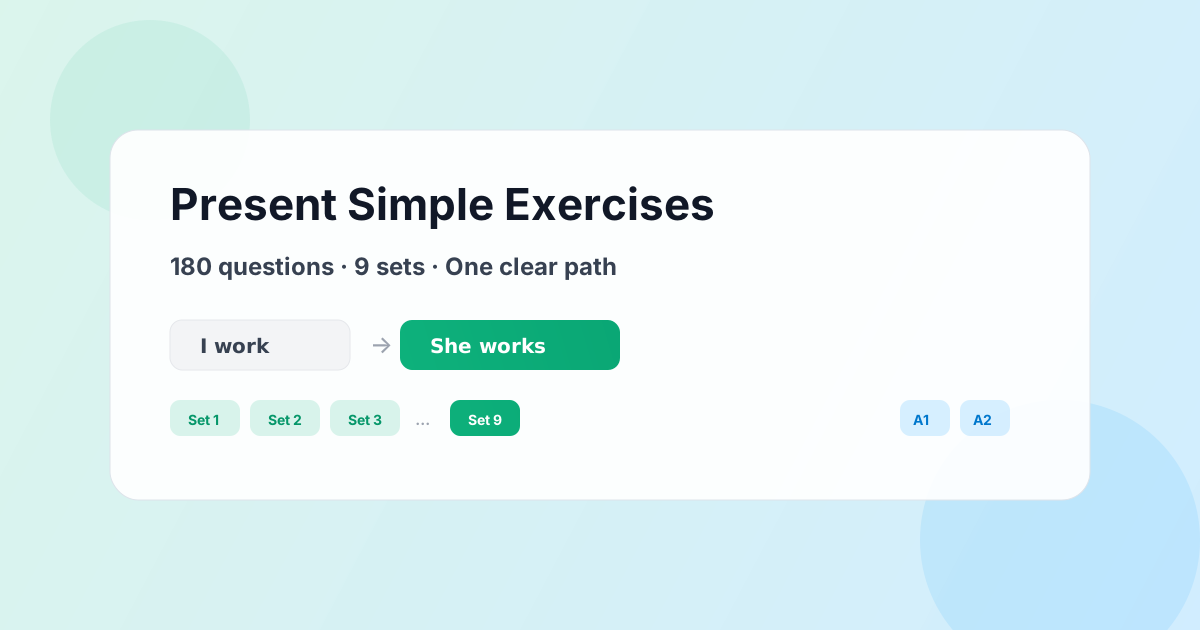
Inside Our Present Simple Exercises: 180 Questions, 9 Sets, One Clear Path
Present Simple is where English grammar begins. It's also where many learners get stuck — not because it's hard, but because they practice randomly without a clear path.
We designed 9 exercise sets (180 questions total) with a specific learning sequence. Here's what's inside and why it's structured this way.
The Learning Path
Sets 1-2: Start with "Be"
The verb "be" (am/is/are) is different from every other verb in English. It doesn't use "do/does" for questions. It has three forms instead of two. It breaks all the rules.
That's why we start here.
| Set | Focus | What You'll Practice |
|---|---|---|
| Set 1 | Be: Affirmative & Negative | I am, she is, they are, he isn't, we aren't |
| Set 2 | Be: Questions & Answers | Are you...? Is she...? Yes, I am. No, she isn't. |
Common mistake we target:
❌ "Yes, I'm." → ✅ "Yes, I am."
Short answers don't use contractions in the positive form. Our exercises drill this until it becomes automatic.
Sets 3-4: Third Person -s
Once "be" clicks, we move to regular verbs. The big challenge? Remembering to add -s for he/she/it.
| Set | Focus | What You'll Practice |
|---|---|---|
| Set 3 | Adding -s | She works. He plays. It costs. |
| Set 4 | Spelling Changes | watch → watches, study → studies, go → goes |
Why a whole set for spelling?
Because "she studys" and "he gos" are everywhere. The rules aren't hard — verbs ending in -ch/-sh/-x/-o add -es, consonant + y becomes -ies — but they need focused practice.
Sets 5-6: Negatives & Questions
Now we add do/does. This is where many learners struggle, because:
- You need doesn't (not "don't") for he/she/it
- The main verb goes back to base form: "She doesn't work" (not
doesn't works)
| Set | Focus | What You'll Practice |
|---|---|---|
| Set 5 | Negatives | I don't like. She doesn't work. |
| Set 6 | Questions | Do you speak...? Does she live...? |
The pattern we reinforce:
do/does + base verb (no -s!)
Set 7: Frequency Adverbs
Always, usually, sometimes, never — these words are Present Simple's best friends. But where do they go?
| Position | Rule | Example |
|---|---|---|
| Before main verb | She always arrives on time. | ✅ |
| After "be" | He is always late. | ✅ |
Set 7 focuses entirely on word order with frequency adverbs — a detail that separates natural English from textbook English.
Set 8: Stative Verbs
Some verbs can't use -ing. Ever.
❌ "I'm knowing the answer." ✅ "I know the answer."
Set 8 covers mental states (know, believe, understand), emotions (love, hate, want), and possession (have, own, belong). These verbs only work in Present Simple.
Set 9: Putting It All Together
The final set mixes everything in real-life contexts:
- Daily routines: "I wake up at 7. She takes the bus."
- Facts & truths: "Water boils at 100°C. The Earth moves around the Sun."
- Timetables: "The train leaves at 9 AM. School starts in September."
Set 9 is where you prove you've got it.
Quick Stats
| Metric | Value |
|---|---|
| Total questions | 180 |
| Exercise sets | 9 |
| Difficulty range | A1 → A2 |
| Estimated time | ~2 hours total |
How to Use These Exercises
If you're a beginner: Go in order. Sets 1-2 first, then 3-4, and so on. Don't skip ahead.
If you want to review: Jump to your weak spot. Mixing up "do" and "does"? Go straight to Sets 5-6.
If you're a teacher: Each set works as a standalone practice unit. Assign them to match your lesson plan.
Ready to start? Begin with Set 1 →
Or read the full Present Simple lesson first.