
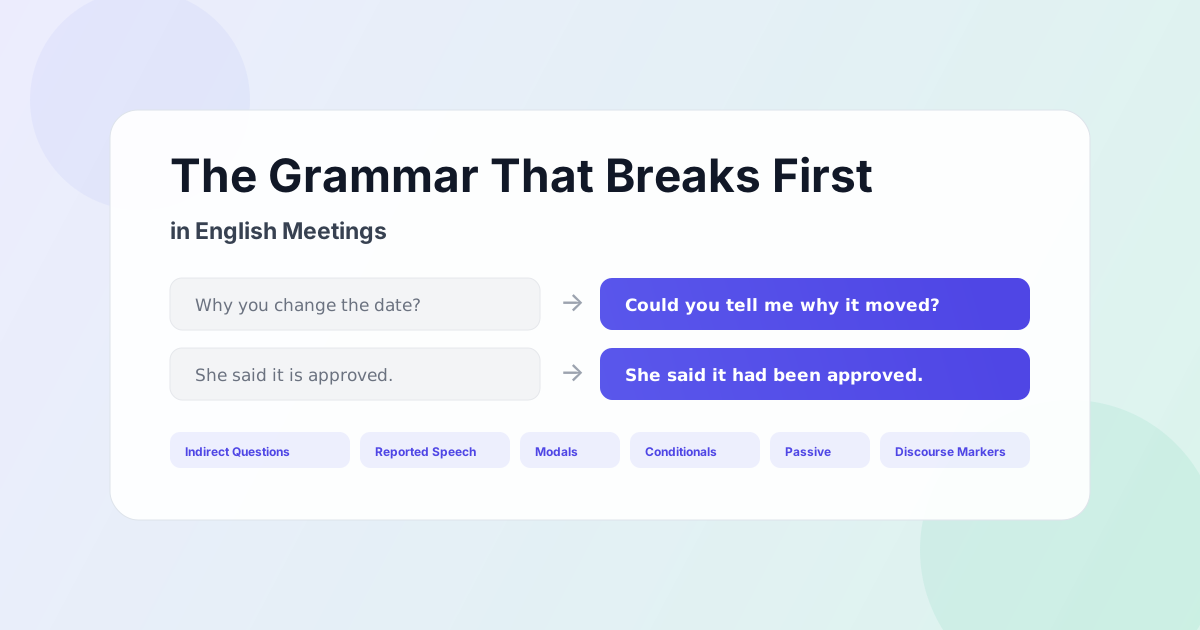
The Grammar That Breaks First in English Meetings
You score well on exercises. You can explain the difference between the present perfect and the past simple. Then a meeting starts, someone says something you half-catch, three people talk over each other, and everything you know collapses into short, flat sentences: "I think yes." "We do it next week." "Maybe problem."
This is not a knowledge problem. It's a retrieval-under-load problem, and it hits some grammar structures much harder than others.
I looked at which topics learners on this site practice most before a job interview or a new role, and compared that to the language that actually does the work in a meeting. Six structures come up over and over — and they're the six that break first.
Why Meetings Are Different
When you do a gap-fill exercise, you have three things a meeting takes away:
- Time. You can reread the sentence, try a form, change your mind.
- A single task. You're only producing language, not simultaneously listening, tracking who said what, and thinking about the actual business problem.
- A finished input. The sentence on screen is complete and correctly spelled. Speech is fast, accented, overlapping, and full of half-sentences.
So the grammar that survives is whatever you've made automatic. Everything else gets dropped in favour of the simplest structure that gets the meaning across — which is why fluent-on-paper learners sound blunt in meetings. It isn't rudeness. It's the present simple being the only thing available at speed.
1. Indirect Questions
Direct questions are the first thing to go, and the cost is bigger than it looks.
- ❌ "Why did you change the deadline?"
- ✅ "Could you walk me through why the deadline moved?"
- ✅ "I was wondering whether the deadline is fixed at this point."
Both mean the same thing. The first one sounds like an accusation in a room of people you don't know well. Indirect questions also carry a word-order trap that's easy to get wrong at speed: after the introductory phrase, the clause goes back to statement order.
- ❌ "Could you tell me what is the timeline?"
- ✅ "Could you tell me what the timeline is?"
Drill this one first — it has the highest politeness-per-unit-of-effort ratio of anything on this list.
2. Modals for Hedging
In most professional cultures that operate in English, flat assertions about uncertain things sound careless. Meetings run on hedged claims.
- "That might be a caching issue."
- "It could be that the data hasn't synced yet."
- "That must have happened during the migration." (deduction about the past)
- "We may need another week." (softer than we need)
The trap for many learners is that may, might, and could are close enough that you can survive with one of them — but must for deduction, and past modals like must have / could have / should have, are the ones that actually mark you as fluent, and they're almost never automatic.
→ Possibility: may, might, could · Deduction and speculation · Past modals
3. Reported Speech
This is the structure meetings demand most and learners practise least. Half of what you say in a meeting is a report of what somebody else said:
- "Sarah mentioned that the client had already approved it."
- "They asked whether we could ship by Friday." (not "could we ship")
- "He suggested postponing the review." (not "suggested to postpone")
Two things break here under pressure: the backshift of tense, and the pattern that follows each reporting verb. Suggest takes -ing or that, ask takes an infinitive or whether, tell needs an object, say doesn't. There's no shortcut — these are memorised, not derived.
→ Reported statements · Reported questions · Reporting verbs
4. Conditionals for Proposals
Almost every proposal in a meeting is a conditional, and the choice between first and second signals how committed you are.
- "If we push the launch, we'll have time to test properly." (first — you're treating it as a real option)
- "If we pushed the launch, we'd have time to test properly." (second — you're floating an idea, more tentative)
Learners who only have the first conditional available end up sounding like they're demanding a change when they meant to suggest one. Having both gives you a volume dial.
5. The Passive
Meetings are full of situations where the actor is unknown, irrelevant, or best left unnamed:
- "The config was changed last Thursday." (rather than naming who broke it)
- "This is being handled by the platform team."
- "The invoices get processed at the end of the month."
The passive is also how you describe processes, which is most of what you do in a status update. Focus on the passive across different tenses, since present simple passive alone won't carry you.
6. Discourse Markers
These aren't grammar in the strict sense, but they do the structural work that makes a long turn followable — and they're the cheapest thing on this list to learn.
- Framing: "To be clear…", "Just to close the loop on that…"
- Contrast: "That said…", "Having said that…", "Then again…"
- Returning: "Coming back to what Sarah raised…"
- Buying time: "Let me think about how to put this."
That last category matters more than people admit. A learner who says "Let me think about how to put this" and then produces a good sentence sounds far more competent than one who fills three seconds with "uh… uh…" and then produces the same sentence.
→ Discourse markers · Contrast and concession
The Half of This That Grammar Practice Can't Fix
Everything above is about production — the language you make. But in most meetings, the thing that actually sinks you is comprehension. You miss one sentence, spend the next twenty seconds reconstructing it, and by the time you're back the topic has moved. Your grammar was never the bottleneck.
There's no drill for this, because the problem isn't your English — it's that native speakers in internal meetings talk fast, overlap, and use company jargon that no textbook contains. Even C1 learners lose chunks of fast multi-speaker audio.
The practical fix is to stop treating it as a language failure and give yourself a text channel alongside the audio. Turning on your meeting platform's built-in captions is the zero-effort version, and it helps. If your meetings are bilingual — a Chinese-speaking team and English-speaking clients, say — a tool like Bicaption runs live captions in both languages side by side in the browser, so you can read the English while it's being spoken and check your understanding against your first language without stopping the meeting to ask. Reading and listening at the same time also happens to be good input practice: you get to see the structures in this article being used in real time, in your own domain, by people you work with.
Either way, the point is the same — spend your attention on speaking, not on decoding. You'll say more, and you'll say it better.
A 15-Minute Weekly Routine
If you only have a few sessions a week before an important role or interview, this is the order I'd use:
- Reported speech, 5 minutes. The highest-frequency, lowest-automaticity structure. Start here.
- Indirect questions, 3 minutes. Fast wins on tone, plus that word-order trap.
- Modals — possibility and deduction, 4 minutes. Rotate in past modals once the present ones are automatic.
- Rotate the rest, 3 minutes. Conditionals one week, passive the next, discourse markers the third.
Then do the thing that actually transfers: after your next real meeting, write down three sentences you wanted to say but couldn't, and rewrite them properly. That gap list is the most useful study material you will ever have, because it's generated by your own job.
Where to Start
- Reported speech exercises — start with reported statements
- Modals exercises — possibility and deduction
- Questions exercises — indirect questions
- Conditionals exercises — first and second
Grammar exercises won't make you comfortable in meetings on their own. But they decide what's still available to you when your attention is somewhere else — and in a meeting, your attention is always somewhere else.